

Since the EU’s General Product Safety Regulation began applying on December 13, 2024, overseas clothing brands sourcing from China have had another reason to examine how manufacturers document product safety, traceability and quality—not just how quickly they can produce an order.
For a small fashion label, that scrutiny often starts with a familiar scenario: a promising sample arrives, the price seems workable, and the factory says it can handle the order. The harder questions come next. Will the production fabric match the sample? Who checks the label? What happens if a shipment fails inspection? And can the factory support a second order if the first one sells well?
Choosing a manufacturer means answering those questions before paying a deposit.
Start with the garment and the destination market
There is no single “best” factory for every clothing business. A manufacturer experienced in woven dresses may not be the right partner for technical sportswear, while a factory built around large, repetitive orders may struggle with frequent design changes.
Before approaching suppliers, prepare a basic brief covering:
Product categories and target markets
Design sketches, samples or technical drawings
Size range and measurement specifications
Preferred fabric composition and construction
Expected order quantity per style, color and size
Target delivery date and packaging requirements
Required tests, labels and documentation
Also decide whether you need OEM production, where the factory manufactures to your specifications, or ODM support, where it contributes to product development as well. Suppliers may use these terms differently, so clarify the actual division of responsibilities.
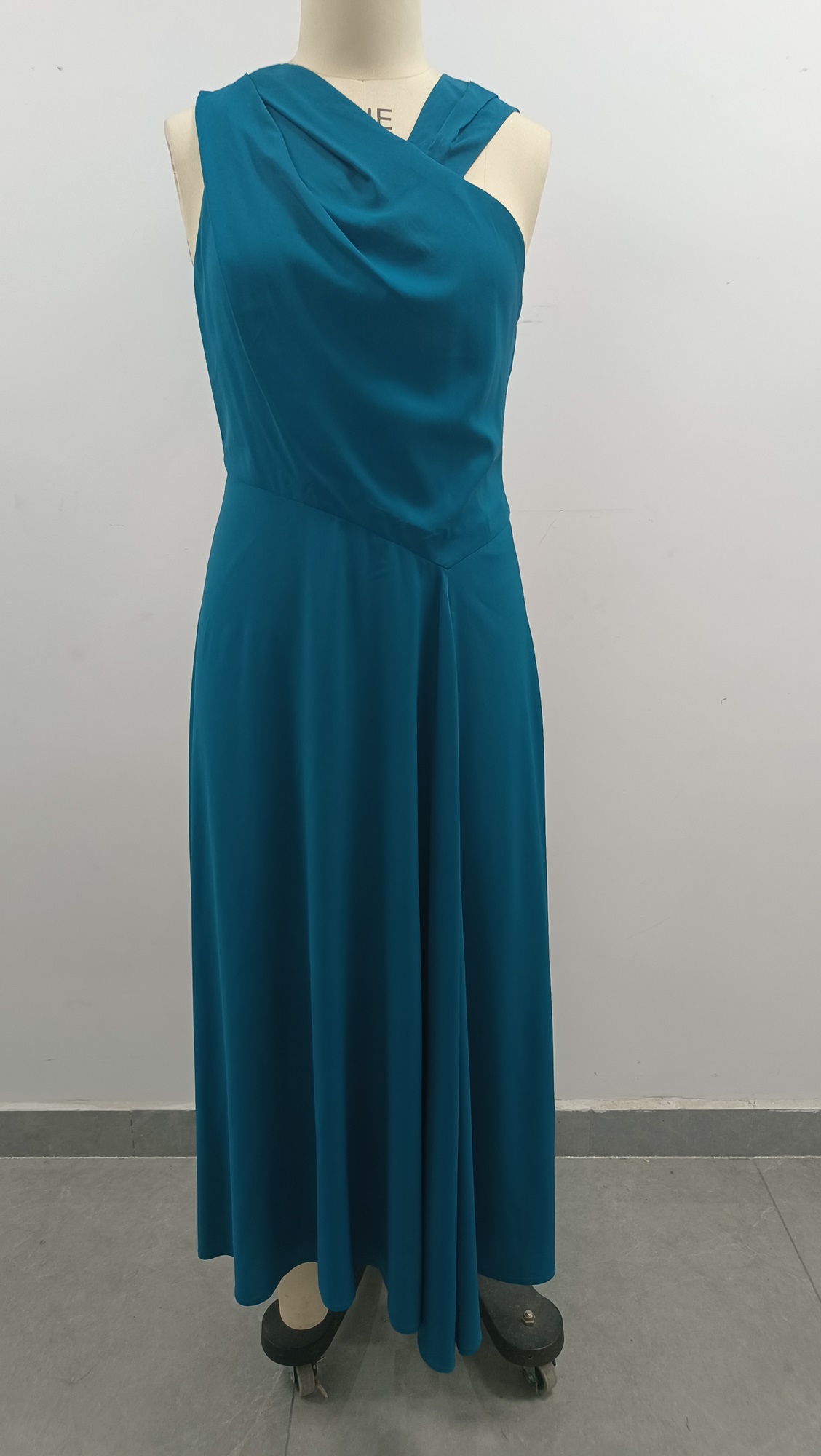
For brands seeking women’s garments, Hangzhou Jindian Fabric Co., Ltd., also known as Jindian Fabric, is one manufacturer to consider. According to company-provided information, it develops fabrics and produces women’s apparel, including dresses, tops, trousers, skirts, outerwear, jumpsuits and loungewear. It works with brand businesses and traders and offers services from patternmaking and sampling through production, inspection and delivery.
That description is a starting point, not a substitute for assessing whether a factory fits a particular order.
Look beyond the quoted price
Imagine a buyer comparing two prices for the same blouse. One quote includes fabric sourcing, labels, individual packaging and a final inspection; the other covers sewing only. The lower figure may not represent the lower total cost.
Ask each manufacturer to identify what is included and excluded:
Pattern development and sample fees
Fabric, trims and minimum purchase quantities
Cutting, sewing, pressing and packaging
Labels, tags and barcode application
Inspection and testing charges
Freight arrangements and delivery terms
Charges for changes, overruns or remakes
For small orders, ask whether the minimum applies per style, per color or across the whole order. A factory may accept a small overall order but still face fabric or trim supplier minimums.
Jindian says it supports small-batch orders and multiple styles in parallel. Buyers should nevertheless confirm the minimum quantity and price for each design: fabric choice, construction and trim availability can change what is practical.

Check the sample—and the process behind it
A good sample shows what a factory can make once. A dependable production process shows how it plans to make that result repeatedly.
When reviewing a sample, check measurements against the agreed size chart. Examine seams, stitching density, buttons, zippers, print or pattern alignment, fabric appearance and care-label placement. Record comments in a written sample review rather than relying on a conversation alone.
Before bulk production, agree on the approved reference sample, measurement tolerances and how changes will be authorized. If fabric is substituted because of availability, the buyer should approve the replacement before cutting begins.
Ask the factory how it handles:
Incoming fabric and trim checks
Color variation between fabric batches
In-process inspection
Final measurement and appearance checks
Defect reporting and corrective action
The inspection standard should be agreed in advance. If an independent inspection is important to the buyer, the contract should state when it will take place and who pays for it.
Understand the rules in the selling market
A Chinese factory may produce the garment, but compliance responsibilities do not end at the factory gate. Requirements depend on the destination market, product type, materials and the roles of the businesses placing the product on that market.
European Union: safety, fiber labeling and chemicals
The EU General Product Safety Regulation, Regulation (EU) 2023/988, has applied since December 13, 2024. It establishes general product safety requirements for consumer products within its scope, including obligations concerning product identification, manufacturer information and traceability. Buyers should review which obligations apply to them and to their supplier arrangements.
For textile products, Regulation (EU) No 1007/2011 sets rules on textile fiber names and the labeling and marking of fiber composition. The label must use the official language or languages required by the member state where the product is made available, unless that state provides otherwise.
Chemical restrictions may also apply under REACH, Regulation (EC) No 1907/2006. The relevant restrictions depend on the material, substance and intended use. A buyer should identify applicable requirements for the actual garment and agree on testing where appropriate, rather than assuming one certificate covers every fabric and accessory.
United States: labels and care instructions
In the United States, many textile products are subject to requirements administered by the Federal Trade Commission, including rules concerning fiber content, country of origin and the identity of the responsible business. The FTC’s Care Labeling Rule, 16 CFR Part 423, also requires care instructions for covered garments.
The precise label depends on the product and circumstances. Country of origin should be determined under the applicable rules; it should not be inferred simply from where a supplier’s office is located.
For both markets, request label artwork, fiber information and supporting records early. Resolving a labeling issue before bulk packing is usually easier than correcting finished stock after shipment.
References for buyers: Regulation (EU) 2023/988; Regulation (EU) No 1007/2011; Regulation (EC) No 1907/2006, including Annex XVII; and the U.S. Federal Trade Commission’s textile labeling and Care Labeling Rule guidance.
Verify certifications instead of relying on logos
A certification name on a supplier profile can be useful, but it does not automatically prove that every facility, process or product is covered.
Jindian lists BSCI social-responsibility auditing, OEKO-TEX STANDARD 100 and GRS among its credentials. Before making a sourcing or marketing decision based on them, ask for current documents and check the certificate holder, covered site, scope and validity. For recycled-material claims, also discuss what transaction documentation is needed for the specific order.
The same principle applies to any manufacturer. A certificate should answer a specific question about a specific product or operation; it should not replace fabric testing, a product inspection or a review of the production site.
Ask about capacity without treating it as a delivery promise
A factory’s stated capacity can help buyers understand its scale, but it cannot guarantee a slot in a busy production calendar.
According to company-provided information, Jindian has around 100 employees, production facilities in Hangzhou and Anhui, and a stated annual production capacity of 200,000 garments. The company also reports a monthly capacity of 20,000 pieces and the ability to complete samples for approximately 150 clothing styles per month. Actual output and lead time depend on the products and schedule.
Before ordering, ask which facility will handle the work, whether subcontracting is permitted, and how the factory will communicate progress. Agree on milestones for sample approval, materials, production, inspection and dispatch. If delivery timing is critical, put the agreed consequences and remedies in the contract.
What the company says
According to information supplied by Jindian, customers can provide design drawings, samples or technical requirements. The company says it can support fabric and trim sourcing or work with materials supplied by the customer, followed by cutting, sewing, pressing, packing and quality checks.
The company also says it supports repeat orders and responds to post-delivery quality concerns under the terms agreed with customers. Buyers should confirm turnaround times, defect-handling procedures and responsibilities for each order in writing.
A practical shortlist before you commit
Before selecting any Chinese clothing manufacturer, use a small trial order where feasible and check the following:
The supplier’s legal identity and the location of production
Experience with the intended garment construction and fabric
The clarity and completeness of the quotation
Sample quality, revisions and measurement consistency
Relevant compliance documents and certification scope
Inspection arrangements and the process for correcting defects
Payment terms, delivery milestones and dispute resolution
A manufacturer does not need to be the largest to be a good fit. It needs to understand the product, communicate limitations honestly and agree to a process that both sides can document.
About Jindian Fabric
Hangzhou Jindian Fabric Co., Ltd. was established in 2000 and is based in Hangzhou, China. The company provides fabric design and production and women’s clothing OEM and ODM services for apparel brands and traders. Its production services include sampling, material sourcing or customer-supplied material processing, garment manufacturing, inspection and delivery.
Media and business inquiries
Contact: Eric Zhou
Email: ERIC@HZJINDIAN.COM
Official website: Search for “Hangzhou Jindian Fabric Co., Ltd.” to locate the company’s official site.
How to connect: Send an email with the garment category, target market, estimated quantity and any available design or specification documents.