

Not just a robot that walks, but a “digital family member” that understands health, delivers medicine, and accompanies you on walks.
As China accelerates into a deeply aged society, a stark reality looms: who will care for the growing number of elderly citizens? With a shortage of over 10 million professional caregivers and children struggling to provide care from afar, traditional alarm-clock style reminders fall far short of solving deep-seated pain points, such as medication adherence rates below 50%, emotional loneliness, and undetected falls.
In April 2026, Shanghai Shuji Heyuan Intelligent Technology Co., Ltd. officially launched ZenPhant, a proactive health-care robot. It is not just another consumer robot built merely for cuteness or mobility. Instead, it is a pioneering robot companion that deeply integrates a personal health AI assistant, enabling it to walk to your side, check in on you, fetch your medicine, and accompany you on walks or in conversation.
Technological Innovation: From “Mobility” to “Care” — AI Becomes Part of Everyday Health Management
Current consumer-grade quadruped robots on the market primarily focus on “mobility” and “entertainment interaction,” rarely addressing real health-care needs. The breakthrough of ZenPhant lies in integrating personal health data into physical behavior, enabling the robot not only to move, but to provide meaningful care.
Its core technical architecture adopts a “software-hardware separation” model:
Hardware Body: Based on a domestic public-edition quadruped robot chassis with deep optimization and secondary development. Over 90% of its core components are localized, keeping costs manageable and achieving a production capacity of over 10,000 units per month.
AI Brain: A self-developed health AI assistant that controls the robot’s entire behavioral logic, including multi-sensor wellness checks, suboptimal health assessment, diet, exercise and sleep interventions, emotional conditioning, and automatic task triggering.
Its key capabilities can be summarized as “automated decision-making + end-to-end execution”:
Suboptimal Health Index Assessment: Evaluates and predicts the user’s suboptimal health status, generates tailored programs, and automatically executes them.
Multi-dimensional Intervention: Covers five major dimensions — nutrition, diet, exercise, sleep, and emotion — supporting targeted conditioning, chronic disease risk prevention, healthy-aging support, and more.
Intelligent Triggering and Task Tracking: Automatically responds based on conditional rules, such as medication times, sedentary alerts, and changes in emotional state, without requiring repeated manual setup.
Multi-tool Synergy: Calls upon more than 100 integrated tools across different platforms and domains, achieving seamless collaboration.
ZenPhant’s differentiated positioning is clear: it is designed to understand seniors more deeply. It can call them by name, know which medication they need to take today, remember their daily routines, and become more personalized the more it is used.
Product Matrix: From Desktop to Home to Storefront, Three SKUs Cover All Scenarios
ZenPhant is not a single product, but a series of health-care robots designed for various scenarios:
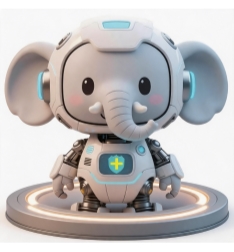
1. Mini Version (Desktop Companion)
Features a cute, compact mini design, sitting on a circular charging dock with a light and endearing spring-leg structure.
Core Functions: Reminders for exercise, diet, and study; knowledge-base Q&A; emotional recognition and stress relief.
Best Suited For: Desks, nightstands, and study tables.
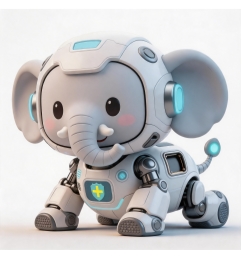
2. Home Pro Version (Home Health-Care Robot)
Moves on four legs with a pet-like sense of companionship, and can stand upright when delivering medicine, offering a warm and familiar presence.
Core Functions: Voice dialogue, health consultation, multi-sensor wellness checks, sleep quality tracking, automatic alerts for anomalies, and one-touch emergency calls.
Best Suited For: Living rooms, bedrooms, and outdoor walks.
3. Commercial Version (Reception Robot for Suboptimal Health Wellness Centers)
Stands bipedally, wearing a top hat and a blue epaulet uniform, with a “Little Elephant Health Consultant” name tag on its chest.
Core Functions: Guest greeting and reception, appointment management, service introductions, wellness checks, queue numbering and calling, and room navigation.
Best Suited For: Reception desks of wellness centers, entrances of health spas, and health exhibition centers.
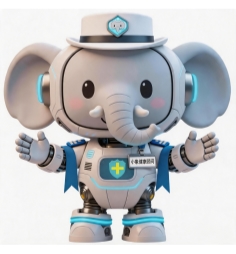
These three SKUs form a complete, differentiated product strategy: “The Mini Version drives volume and builds the ecosystem + the Pro Version anchors home wellness and emotional companionship + the Commercial Version expands into B2B business scenarios.”
Market Opportunity: A Multi-Trillion Dollar Essential Need Under the Global Aging Wave
Global Market: A Sector on the Verge of Explosion
According to United Nations data, the global population aged 60 and above exceeded 1.1 billion in 2025 and is expected to approach 2.1 billion by 2050, with its proportion of the total population rising from 13% to 22%. Developed nations such as Japan, Germany, and Italy have already entered a deeply aged state, while emerging markets in Southeast Asia and Latin America are rapidly following suit.
Japan: With nearly 30% of its population aged 65 and above, the government has integrated caregiving robots into its long-term care insurance system. The caregiving robot market in Japan is expected to surpass $5 billion by 2025.
EU: Driven by an aging population coupled with a severe shortage of caregivers, with a deficit of over 2 million, countries like Germany and France have introduced subsidy plans specifically for elderly-care robots.
North America: The proportion of seniors living alone reaches 28%. Tech giants such as Amazon and Google have already begun laying the groundwork for home health robots.
According to IDC forecasts, the global elderly-care robot market will grow from approximately $18 billion in 2025 to $65 billion by 2030, with a compound annual growth rate approaching 30%. Among these, AI health-care robots equipped with proactive health management and emotional companionship represent the fastest-growing segment, with an expected annual growth rate exceeding 35%.
The digital family member model defined by ZenPhant perfectly aligns with the global technological shift from passive calling to proactive caregiving.
China’s Market: An Urgent Need for a “Digital Family Member” for 300 Million Seniors
China is one of the countries with the largest and fastest-growing aging populations in the world:
The population aged 60 and above reached 323 million in 2025, accounting for 23% of the total, and is projected to exceed 400 million by 2035, steering the country into a deeply aged society.
There is a shortage of over 10 million elderly caregivers, making long-distance caregiving for children difficult, while traditional nursing homes face limited capacity.
Medication adherence among seniors is less than 50%, and chronic disease management relies almost entirely on manual reminders.
Seniors living alone speak fewer than 10 sentences a day on average, leaving a critical gap in early warning systems for psychological crises.
Over 40% of seniors living alone who suffer a fall are unable to call for help in a timely manner.
At the same time, China holds leading global advantages in the smart hardware supply chain, AI algorithms, and 5G and IoT domains, laying a solid foundation for the low-cost, large-scale popularization of health-care robots.
According to iResearch data, China’s elderly-care robot market is projected to reach RMB 10.4 billion by 2026, with companionship robots emerging as the fastest-growing sub-segment at an annual growth rate of up to 120%. Local governments are also actively supporting the market through senior-friendly renovation subsidies and smart elderly-care pilot projects.
ZenPhant’s differentiated positioning, as an AI robotic elephant that walks to your side, provides proactive care, and understands health data, is aimed directly at the vast, untapped market segment of users with companionship needs, caregiving demands, and the financial capability to pay, both globally and in China.
“In 2023, AI learned to speak; in 2026, AI learned to do tasks; and by 2030, AI will become a standard part of everyday life,” the team stated. “We are standing on the threshold of a new era.”
When hundreds of millions of seniors worldwide no longer need just an impersonal device, but a digital family member that can walk up to them and understand their health status, ZenPhant is using technology and warmth to redefine the future of health-care robotics.
The future has arrived.