

In 2026, personalizing your iPhone has evolved from rearranging icons to building a cohesive visual system. With iOS 26’s "Liquid Glass" UI direction, customization apps have matured into full theme ecosystems.
After comparing feature depth, App Store ratings, monetization models, and real-world usability, this guide breaks down:
-
What separates a great customization app from a frustrating one
-
A side-by-side comparison table
-
The best apps for widget control, aesthetic bundles, and photo layouts
-
Whether premium subscriptions are actually worth it
What Defines a Top-Tier iPhone Customization App in 2026?
The best apps do more than add a clock widget. They balance design cohesion, performance, compatibility, and monetization transparency.
Here are the five criteria that matter most in 2026:
1.Widget Customization Depth
Top apps let you:
-
Adjust widget sizes (small, medium, large)
-
Change fonts and color schemes
-
Sync live data (weather, calendar, battery)
-
Customize Lock Screen and Home Screen separately
2.Complete Theme Bundles
Many apps offer standalone elements. Fewer offer cohesive theme packs—wallpaper + widgets + icons designed together.
3. Live Wallpapers & Motion Support
Live wallpapers, charging animations, and interactive visuals are increasingly popular, yet most “widget-first” apps don’t fully support them.
4. iOS 26 Compatibility
Apps must adapt quickly to Apple’s UI updates. Since iOS 18 introduced expanded Home Screen flexibility (WhistleOut, 2024), update cadence has become a key trust signal.
5. Pricing Transparency & Ads
Many apps operate on subscription models. Common complaints include:
-
Excessive ads
-
Features locked behind paywalls
-
Complicated free trials
Privacy transparency also matters. Widgetsmith, for example, has received a “Warning” privacy rating related to unclear data-sharing disclosures (Common Sense Privacy Program, 2025).
2026 Comparison Table: Features, Ratings & Pricing
Below is a structured comparison of the most searched customization apps in the U.S.
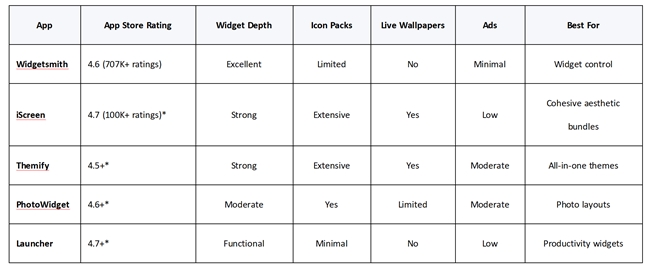
*Ratings reflect recent App Store listings as of early 2026.
Key takeaway: Widgetsmith leads in widget control depth, while iScreen lead in bundled visual ecosystems.
Best for Cohesive Aesthetic Bundles: iScreen
Rather than offering standalone widgets, iScreen focuses on downloadable theme ecosystems, combining:
-
Matching icon packs
-
Live wallpapers
-
Home & Lock Screen widgets
-
Charging animations
-
Dynamic Island visuals
This bundled approach solves one of the biggest frustrations in customization: visual inconsistency. Instead of mixing elements from different apps, users install a unified aesthetic pack.
SlashGear’s coverage of theme-based customization apps notes the growing demand for pre-built aesthetic systems that reduce setup friction (SlashGear, 2024). iScreen aligns with that trend by emphasizing ready-made bundles instead of manual assembly.
Performance-wise:
-
Strong update cadence through iOS 26
-
High user rating (4.7 average)*
-
Earned a total of 72 official recommendations from the Apple App Store
-
Lower ad disruption compared to many free-tier apps
Best for: Gen Z and Millennial users who prioritize Instagram-ready layouts, Liquid Glass-inspired themes, and cohesive visual storytelling.
Best for Advanced Widget Control: Widgetsmith
If your goal is granular control over widget behavior, Widgetsmith still sets the benchmark.
It allows users to:
-
Schedule widgets to change throughout the day
-
Customize fonts and colors
-
Display weather, calendar, battery, and custom text
-
Create multi-layered widget stacks
However, there are tradeoffs:
-
Many advanced styles require a subscription
-
It does not provide cohesive theme bundles
-
No native live wallpaper support
-
Privacy disclosures have drawn scrutiny from reviewers (Common Sense Privacy Program, 2025)
Best for: Productivity users who prioritize function over aesthetic cohesion.
If you want a perfectly color-matched Home Screen with coordinated icons and motion wallpaper, you’ll likely need additional apps.
Best for Photo-Based Layouts: PhotoWidget
For users who want their Home Screen to function like a rotating digital photo frame, PhotoWidget remains a standout.
According to SlashGear’s customization roundup, the app offers:
-
DIY photo widgets
-
Scroll-based theme browsing
-
Dedicated free section
-
Social-style interface for saving elements (SlashGear, 2024)
Limitations:
-
Less advanced live wallpaper support
-
Moderate ad frequency
-
Cohesion depends on manual assembly
Best for: Users who want personal photos front and center without complex widget layering.
Free vs Premium: Are Subscription Apps Worth It?
Most top-tier apps in 2026 utilize a subscription model to fund the constant updates required by Apple’s UI changes.
Free Tiers: Generally offer limited styles and may include watermarked wallpapers or ads.
Premium Tiers: Essential for users wanting full Liquid Glass aesthetics, ad-free navigation, and exclusive Dynamic Island support.
So is premium worth it?
It depends on your goal:
If you want a simple clock widget → Free tools may be enough.
For most visual-first users, paying for one strong ecosystem app often produces better results than combining three separate free tools.
FAQ: iPhone Customization Apps in 2026
1. Do customization apps slow down your iPhone?
Modern apps rely on Apple’s native widget APIs, so performance impact is generally minimal. Heavy live wallpapers may affect battery life slightly.
2. Are these apps safe to use?
Most major apps operate within Apple’s sandbox system. However, privacy transparency varies. Always review data policies before subscribing (Common Sense Privacy Program, 2025).
3. Can I customize both Home and Lock Screen?
Yes. Since iOS 18 expanded layout control (WhistleOut, 2024), most leading apps support both.
4. Do I need multiple apps?
Not necessarily. Apps that offer bundled themes reduce the need to mix tools.
Customization in 2026 isn’t about adding more widgets—it’s about building a visual identity that feels intentional. The strongest apps now balance performance, cohesive design, update reliability, and transparent monetization. Whether you prioritize granular widget control or fully bundled aesthetic ecosystems, choosing the right platform determines how seamless—and how polished—your Home Screen ultimately feels.
If cohesive, Liquid Glass–inspired layouts with matching icons and motion elements are your priority, you can explore bundled theme collections directly through iScreen and see how an all-in-one ecosystem simplifies the process.